
The Word Trump and Mamdani Have in Common
Trump and Mamdani say "they" more than other politicians, but with opposite meanings.
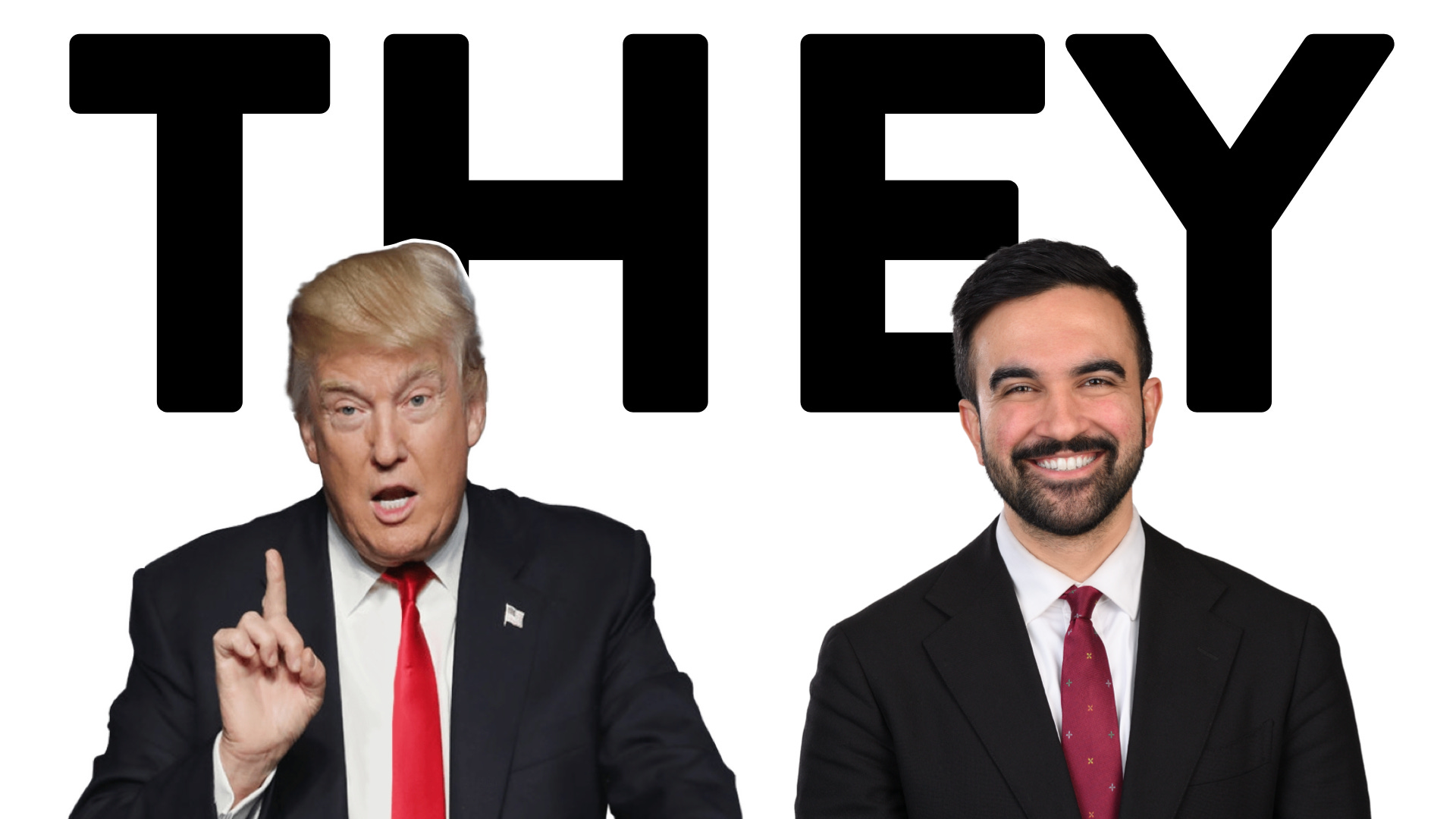
New science about storytelling shows the politicians who are the yin and yang of contemporary America, Donald Trump and Zohran Mamdani, have something important in common.
Recent evidence from anthropology, psychology, neuroscience, primatology, and other sciences provides pieces of a long unsolved puzzle we may at last be about to complete: how and why language evolved. The answer appears to be stories—that language did not give us stories; stories gave us language.
About a million years ago, humans learned to make fires at night. The light was too dim for primate socializing like gestures and grooming, so they repurposed the calls and cries they made about present, urgent things like predators to communicate about non-urgent, absent things they remembered and imagined instead. Over hundreds of thousands of years, beside hundreds of millions of fires, our ancestors got ever better at telling what we now call stories. The strongest, fittest stories developed a particular shape: they were struggles between heroes representing “we” and villains representing “they” that improved group bonding and therefore survival and reproduction. Storytelling created the evolutionary pressure that turned calls and cries into language.
The storytelling origin of language helps explain something else uniquely human: why we kill each other so much. One in four humans are killed by other humans—some by violence and the rest by systemic oppression. In other mammals, fewer than one in three hundred deaths are caused by members of the same species.
What makes humans so murderous is our willingness to kill strangers. In 1954, psychologist Gordon Allport showed how stigmatizing groups of people as “they” starts with jokes, becomes slurs and hate speech, and can ultimately cause genocide. Our entire concept of us and them arises not from reality but from stories.
Both Trump and Mamdani use “they” to refer to groups of people such as immigrants far more frequently than other politicians. Trump uses group “they” 14.2 times per thousand words. Mamdani uses group “they” 14 times per thousand words. This is significantly higher than Bernie Sanders, who comes in third with 12.4, and fifty percent more than the average.
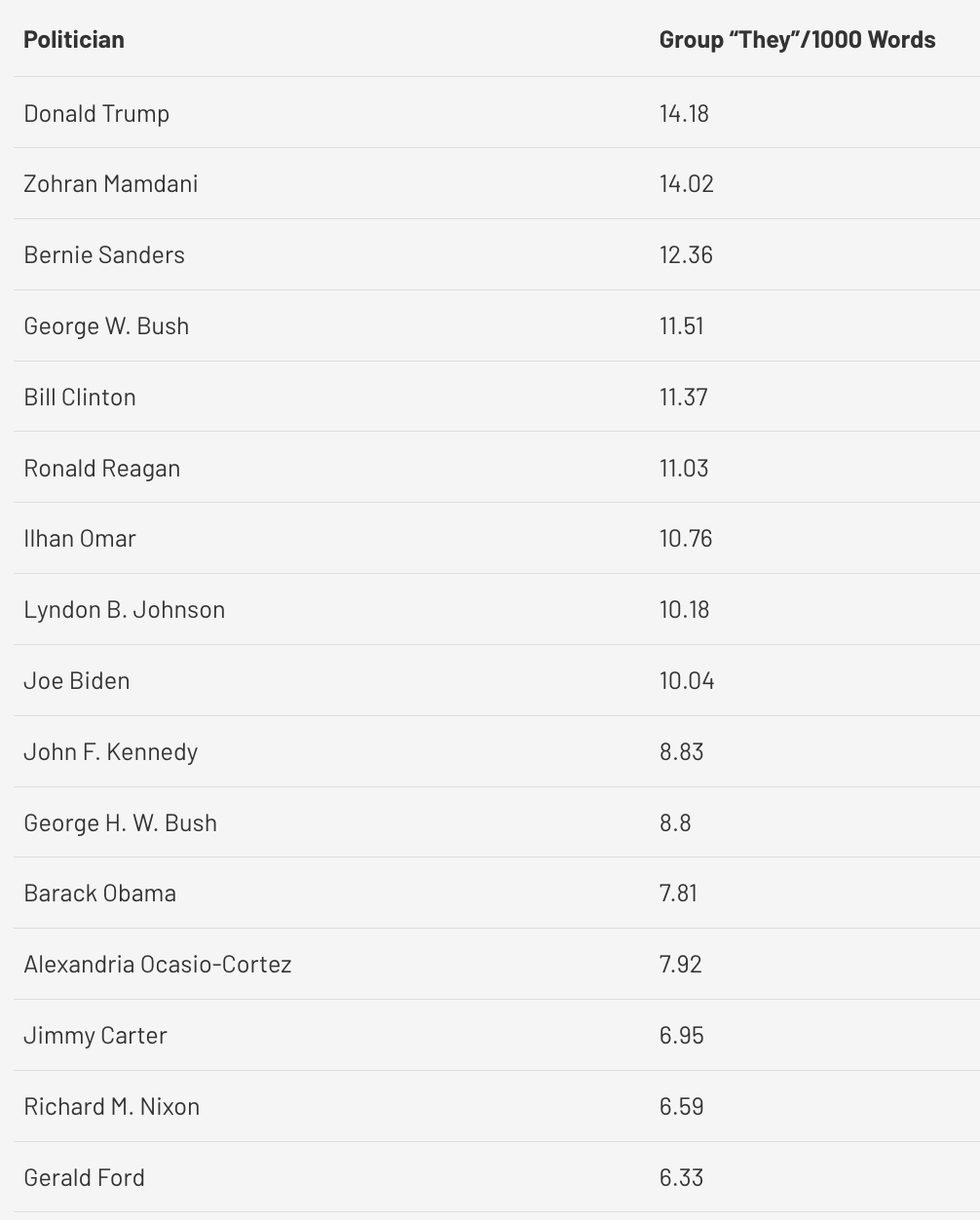
Trump and Mamdani deploy their large numbers of “theys” in opposite ways.
Trump uses “they” to refer mainly to people with less power and is negative and divisive: “They poured in by the millions and millions from prisons, from mental institutions.” Mamdani also uses “they” to refer mainly to people with less power but is positive and inclusive: “They came here with a dream, and they were told that if they worked hard enough, that dream would be theirs.”
The difference between Trump’s and Mamdani’s “they” goes beyond negative and positive. Trump denies human characteristics, such as morality and reason, and aspects of human nature, such as agency and warmth, to make the people he calls “they” seem like animals: “We take them out by the thousands. And they are monsters.” Only James Madison and James Monroe animalized “they” as much as Trump. Both spent the early 1800s killing tens of thousands of Indigenous Americans while calling them “savages.” Meanwhile Mamdani emphasizes human characteristics and human nature to make the people he calls “they” seem like us, and does so more than any other politician: “It will be a tale of eight and a half million cities, each of them a New Yorker with hopes and fears, each a universe, each of them woven together.”
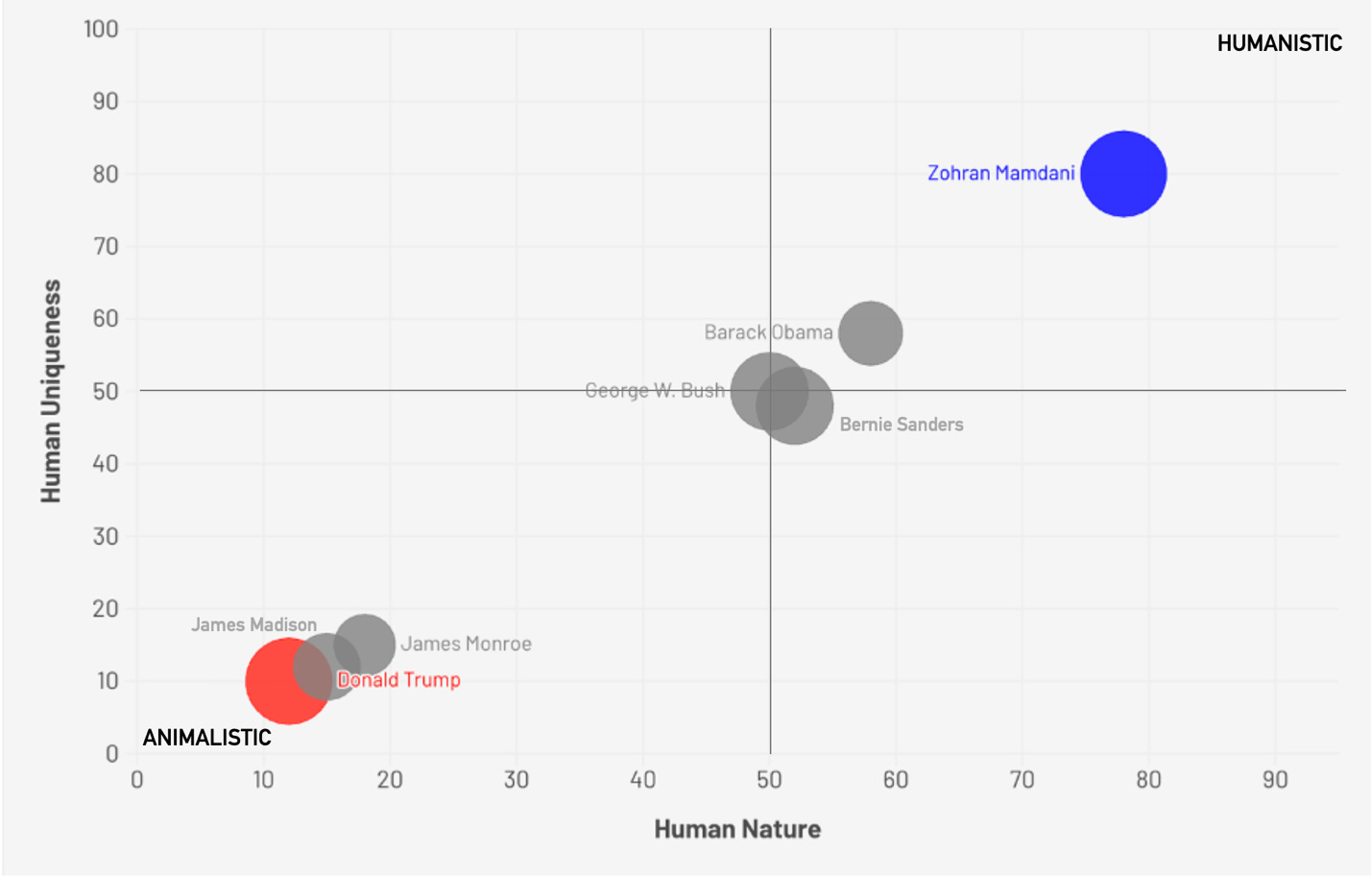
These differences are more than semantic. About half our brain evolved after our ancestors started lighting nightfires, mostly for storytelling and language. Stories tell us almost everything we know about the world. One thing we learn from stories and therefore from politicians like Trump and Mamdani is who deserves to be treated as human and who does not. What follows is opportunity, oppression, and other consequences including, sometimes, us killing strangers or strangers killing us.