
Trump Can Easily Become President for Life
Experts who think otherwise are blinded by old stories.
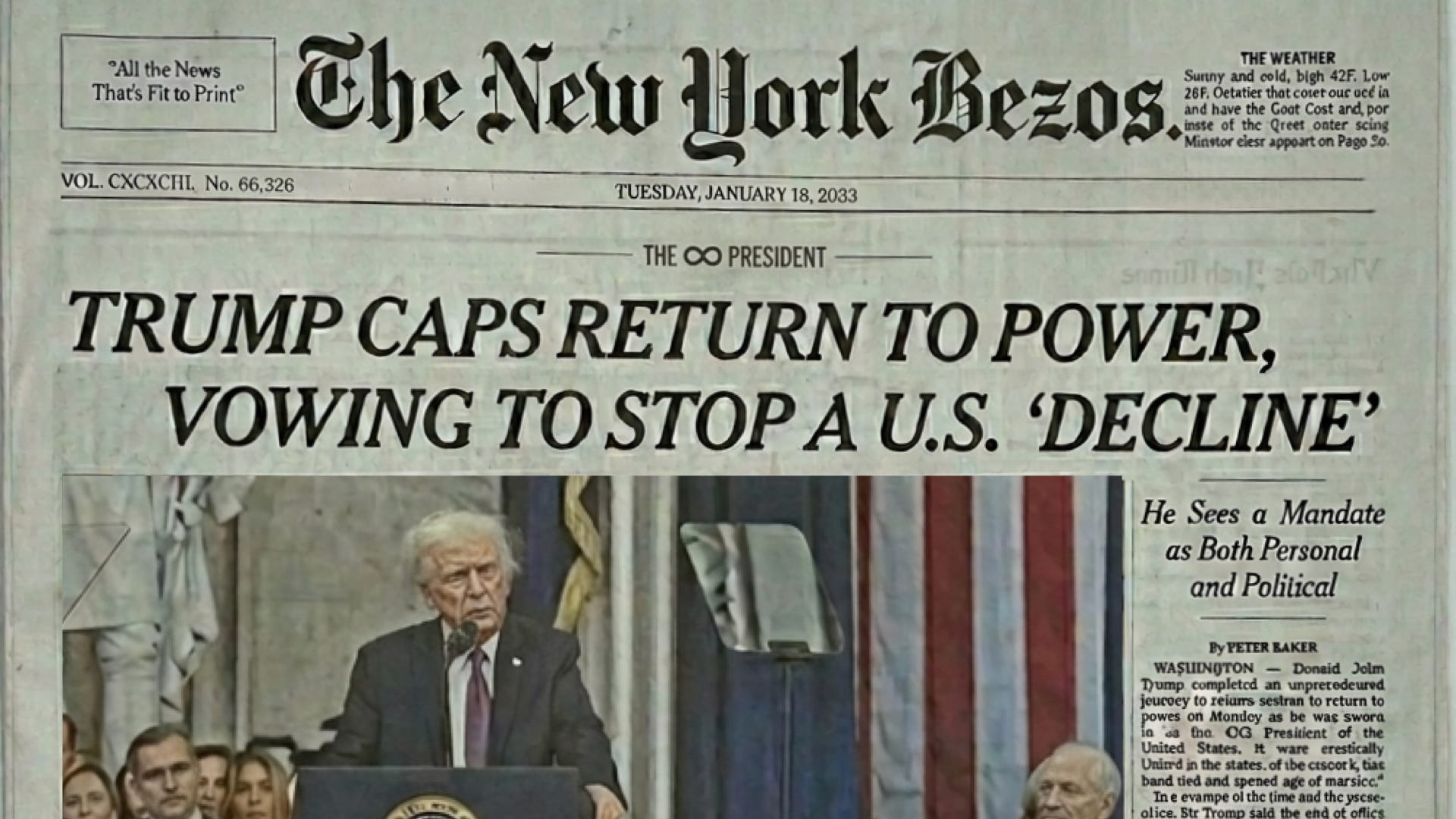
In the 1980s, pathologists were missing something hiding in plain sight. Not because they lacked skill or attention, but because they knew it was impossible.
Scientists knew the stomach is sterile: Acid destroys bacteria, therefore bacteria cannot survive in the stomach. So when pathologists examined stomach biopsy slides under their microscopes, bacteria called Helicobacter pylori—present on the slides, stained, and obvious—were invisible to them. Not metaphorically invisible. Literally invisible. Their brains filtered the bacteria out before consciousness could register them. The impossible cannot exist so the impossible is not seen.
When two Australian scientists named Barry Marshall and Robin Warren proved the existence of Helicobacter pylori in 1984, pathologists went back to their own archived slides and for the first time saw bacteria that had always been there.
This is why America’s constitutional scholars, legal commentators, democratic theorists, and other experts do not see what is already visible: how easy it is for Donald Trump to become president for life.
America has a story it tells itself about itself: the Constitution created a system of checks and balances no individual can overcome. The courts are independent. The military serves the Constitution. Power transfers peacefully. The story is believed with what may as well be religious conviction by the people whose professional lives depend on it—constitutional lawyers, political scientists, federal judges, journalists, and other experts who will scoff at the naivety of this article.
But the bacteria are on their slides.
The Supreme Court has five justices who vote to give Donald Trump whatever he needs. This is not speculation. It is demonstrated behavior. The Court created presidential immunity from prosecution from nothing in 2024. It uses its emergency docket—a procedure requiring no full argument, no written explanation, accountable to no one, a sham settlers on America’s 19th century lawless frontiers would have recognized as a “kangaroo court”—to reshape election law repeatedly, each time in directions that benefit Republican candidates and harm Democratic ones.
This week the Supreme Court signaled it will strike down grace periods for mail-in ballots in fourteen states, while making sure its ruling will take effect before the November midterms. Justice Kavanaugh asked the Republican Party’s lawyer whether there would be enough time to implement the decision before the election—a logistical question, not a legal one. The court is explicitly seeking to schedule voter suppression before people vote. All the evidence points in the same direction: the conservative majority works for Trump not the United States and reads the Constitution and law only when looking to excuse its pretextual rulings.
Which brings us to how easy it is for Trump to stay in power forever.
The 22nd Amendment says “no person shall be elected president more than twice.” But a sufficiently corrupt Court—and we have one—can make any ruling it wants. It can say “elected” only applies if we hold elections which, for some reason, we cannot. Or that the originalist definition of “twice” actually means “as often as you like,” according to some previously obscure scrap of medieval English law. Or it can use its kangaroo court emergency docket to simply declare Trump president for life with no explanation whatsoever.
And that is all it takes. A president not ashamed to ask for it, and a court not ashamed to give it to him.
If you do not believe me, ask your favorite constitutional scholar a question: if the court ruled Trump could stay in office forever, what would be the recourse? What could anyone do?
The answer is nothing. There is no court of appeal, no practical limit on the Supreme Court’s power, no escape from a corrupt decision. This is why the expert answer is always “it will never happen.” Because if it does happen, there is no way to reverse it. Despite every story you have ever been told about the United States being a “nation of laws,” five people on One First Street NE, Washington DC, can rule anything is legal.
Thomas Kuhn, a historian and philosopher of science, observed that scientific communities operate within the constraints of stories he called “paradigms”—frameworks that determine not only what explanations are accepted but what questions can be asked and what evidence can be seen. When anomalies appear, they are treated as puzzles to be explained away, not as evidence that the paradigm is wrong. Any scientist who suggests the paradigm is failing is considered foolish.
Experts who have now spent over ten years explaining why Trump’s latest action is unprecedented but containable are like those scientists. Each outrage is a puzzle, an exception, not a sign that their priors are wrong. Anomalies that have occurred daily for a decade are still anomalous. Norms are still norms no matter how many times they have been broken. The bacteria on the slides are not on the slides.
The structure of human brains make this worse. Confidence produces a neural gating effect in which confirmatory information is amplified and disconfirmatory information is deleted before it even reaches conscious processing. The more expert someone is, the more strongly their brain prevents them from realizing their expertise is failing. The people most qualified to sound the alarm are the people least neurologically able to see the fire.
The story of American democracy—separation of powers, independent judiciary, peaceful transfer, self-correcting institutions—has a property that makes it especially resistant to revision: if it is false the careers and identities of the people telling the story collapse. And so the story has to be true. The stakes make anything else literally unthinkable.
Donald Trump is 78. His mother lived to 88. His father to 93 years 8 months. Trump’s generation lives far longer than his parents’ generation. It is quite possible he will live well into his 90s. Four more terms takes him to 2041 and the age of 94 years 7 months—less than a year older than his father’s age at death.
This is not a prediction. It is a description of a path that is open and being walked, and why the people who don’t expect to see it cannot.
The bacteria are on the slides, and they have been visible for years.
For more stuff like this, see my book, The Story of Stories.
For a demonstration of inattentional blindness, take another look at the name of the newspaper in the picture above.